Showing posts with label Answer Engine Optimization. Show all posts

Monday, 2 November 2026

Can AI Search Understand Your Service Page Without Guessing?


Can AI Search Understand Your Service Page Without Guessing?


A homeowner needs someone to repair a leaking basement wall. They find a local contractor's website, but the page talks mostly about “complete property solutions” and “quality you can trust.” Does the company fix active leaks, or does it only waterproof new construction? The answer is nowhere obvious.

Answer Engine Optimization (AEO) is about making useful information accessible for answer-focused searches. It is not a promise that an AI system will quote or recommend a business.

Key Takeaways

  • Name the exact problem each service solves.
  • Explain what is included and what is not.
  • Be specific about where and for whom the service is available.
  • Describe the steps customers should expect.
  • Keep important facts accurate across your website.
  • Use everyday questions to find missing explanations.

Describe the Job, Not Just the Business

Small-business owners know their own services so well that they sometimes skip details customers need. A contractor might write “basement solutions” because the phrase covers several jobs internally. But a homeowner wants to know whether the company handles crack injection, exterior waterproofing, or moisture inspections.

One helpful approach is to start each page with a plain description of the actual job. Follow it with the kinds of problems the service is intended to address.

For example: “We inspect basement moisture problems and recommend repairs based on the cause. Waterproofing work is quoted separately.” This is clearer than claiming to solve every basement issue.

Tell People When the Service Is Not a Fit

Many websites are comfortable describing who they help but reluctant to say what they do not offer. That can lead to enquiries from people the business cannot serve.

Imagine a pet-care business that offers daytime dog walking but no overnight stays. If its page says only “complete pet care,” someone planning a week away may assume boarding is available.

A short sentence about the limitation saves everyone time. The same applies to property types, appointment requirements, minimum project sizes, and geographical coverage.

For a business serving Toronto and nearby areas, a service-area statement should reflect where appointments can actually be arranged. If certain areas have different availability or travel conditions, say so without adding a long list of city names purely for search keywords.

Walk Through What Happens After Someone Enquires

A visitor may understand the service but still feel uncertain about the process. Will someone inspect the property before quoting? Is payment required in advance? What should the customer prepare?

Take a fictional window-repair company. A helpful explanation might say that the customer first shares photos and measurements, the team checks whether replacement parts are available, and an estimate follows if the job is suitable.

Where the next step requires approval, an inspection, or extra information, explain that early. A short process description can reduce repetitive questions and set more realistic expectations.

For businesses working on service content, this guide to writing service pages for AI search and AEO explores how definitions, page sections, and supporting information can fit together.

Check the Facts in More Than One Place

A company can publish a clear page and still confuse customers if other parts of the website tell a different story.

Perhaps the service page says appointments are available on Saturdays, while the booking information says weekdays only. Or an older blog post describes a service the company has discontinued.

Make a simple list of facts that must agree: service names, areas covered, eligibility, booking steps, hours when relevant, and major exclusions. Compare them across the homepage, service pages, FAQs, and other business information the company controls.

If a fact changes, update the places where customers are likely to encounter it. Keep a named person responsible for these checks rather than assuming someone else will notice.

Let Real Questions Guide the Next Update

Some website improvements are easy to overlook because the business sees its own content every day. Customer questions offer a useful outside perspective.

Ask whoever answers the phone or email which questions keep coming up. Do people misunderstand the service area? Do they expect a task that is not included? Do they ask what happens after the first appointment?

Choose one recurring question and find where a visitor would reasonably expect its answer. Add or revise that explanation in the relevant section instead of hiding everything in a large FAQ.

Then pay attention to whether customer conversations become more specific.

Frequently Asked Questions

Can AI search understand a service page with very little text?

It may be able to use some information, but a short page can leave important questions unanswered. There is no reliable word-count formula that guarantees an AI system will understand or feature a business. Include enough detail to explain the actual service, audience, conditions, and process. Avoid adding filler simply to make the page longer.

Should a small business put every service on one page?

Not necessarily. A single page can work when services are closely related and easy to compare. Separate pages may help when the work, intended customer, or requirements differ. For example, a cleaning business may need distinct explanations for regular home cleaning and move-out cleaning because preparation and scope can vary. Choose the arrangement customers can navigate comfortably.

Is adding a FAQ enough for Answer Engine Optimization?

No. FAQs can answer specific questions, but they cannot replace a useful main service description. If visitors need to know what is included, explain it in the service section where they will look first. Use FAQs for additional questions about preparation, exceptions, or next steps. Keep answers accurate and avoid claiming that a particular format guarantees citations.

What is the easiest way to check whether a page is clear?

Show it to someone who does not know the business. Ask them to describe the service, identify who it is for, and explain what they would do next. Do not coach them while they read. Write down where they hesitate, then compare those gaps with questions customers already ask. Fix the most important missing facts before changing decorative details.

Clear Answers Are Useful Even Without AI

A strong service page does not need to sound complicated. It should tell a potential customer what the business does, where it works, what the service involves, and which limits matter.

Those explanations can make ordinary browsing and customer conversations easier. They also provide a sensible foundation for anyone thinking about AI-assisted discovery, without promising that a search system will select the page.

The simplest test remains a human one: can a first-time reader understand the service without having to guess?


Monday, 27 October 2025

Buyers Don’t Read-They Ask. If AI can’t quote your page in 30–80 words, you’re invisible.


Buyers Don’t Read-They Ask. If AI can’t quote your page in 30–80 words, you’re invisible.


Your buyer isn’t curled up with your homepage. They’re in a lineup, juggling a coffee and a notification storm, asking their phone one simple thing: “How much? How long? Do you do it near me?” If your page doesn’t serve a tight, quotable answer that AI can lift word-for-word, you’re not just lower on the page-you’re not there at all. This article is the punchier twin of our AEO playbook-same brains, more bite.


What “Be the Answer” Means

“Be the answer” means your page makes three things instant:

●     Clarity: A human gets it on the first read.

●     Extractability: An assistant can copy it cleanly.

●     Action: The next step is obvious.

If a stranger can repeat your promise in one breath- “They do X for Y in Z time/cost.”-you’ve nailed it.


Bar chart comparing AEO and SEO metrics: AEO shows higher conversion (6.7% vs 2.1%), lower bounce (39% vs 68%), longer page time (72s vs 34s), more AI snippets (23% vs 2%), and higher lead-to-booking (10.4% vs 3.5%).


The 30–80 Word Rule (and why it prints money)

Long copy can persuade. Short answers decide. The sweet spot for AI-quotable explanations is 30–80 words: one concrete promise, one number or timeframe, simple words, and a single action.

Why it works:

●     Cognitive load: Less decoding, faster decisions.

●     Voice/AI fit: Perfect size for spoken/read-out answers.

●     Skimmability: Mobile brains skim, they don’t study.

Litmus test: If your answer can’t be read aloud in a breath or two, it’s probably fluff.


 Your Page, Rebuilt for Answers

Stop stacking paragraphs. Start stacking questions.

Above the fold

●     One-sentence promise.

●     A tiny Quick Answer box (2–3 sentences).

●     One action (book/call/quote). Pick one.

Body

●     3–6 question-first sections (H2s).

●     Each section: a 30–80-word answer → a tiny list of steps (3 bullets max) → one action.

●     Add proof slices where it matters (see Section 6).

Footer area (optional on landing pages)

●     Hours, service areas, and a “Last reviewed” date.


Bar chart titled “Update Frequency vs AI Visibility” showing that more frequent updates lead to higher AI visibility and user trust. Monthly updates score highest with 28% visibility and a 9 trust score, while never-updated sites have 2% visibility and a 3 trust score.


Write It Like This (mini playbook + examples)

The Playbook

  1. Lead with the outcome
     What happens for the buyer, specifically?

  2. Drop one number or timeframe
     Price range, days, minutes, capacity, distance.

  3. Use short, active sentences
     Cut hedges (“we strive to…”) and mush (“solutions,” “synergies”).

  4. Match the question’s wording
     If buyers say “how much,” you say how much.

  5. End with one action
     Book, call, get a quote. No crossroads.

Before/After (service business)

Before:

Our integrated, full-stack solutions optimise omnichannel outcomes.

After (43 words):

We install heat pumps within 48–72 hours after a quick assessment. Our team handles permits, delivery, and testing so you’re up and running fast-even in peak season. Want a price range before we visit? Most installs land between $X–$Y. Get a 24-hour quote.

Why this wins: One outcome, one timeframe, one range, one action. Copyable. Speakable.

Before/After (clinic)

Before:

We deliver bespoke aesthetic enhancements tailored to your unique beauty goals.

After (51 words):

First-time lip filler sessions start from $450 and typically use 1–2 syringes. Expect a 30–45-minute appointment, numbing included, and visible results the same day. Swelling settles in 48–72 hours. See if you’re a fit in two minutes-check availability and pick a slot.

Before/After (restaurant group)

Before:

Our culinary team crafts an elevated experience for discerning palates.

After (39 words):

We cater offices from 10–150 ppl with delivery in under 90 minutes in the core. Choose set menus or build-your-own. We label allergens and offer peanut-aware options. Need same-day? Call by 10 a.m. See today’s menu.


Proof Beats Prose (numbers, dates, and receipts)

Trust isn’t a vibe; it’s evidence:

●     Numbers: Price ranges, durations, capacity, response times.

●     Process: 3 plain-English steps, no jargon.

●     Freshness: A visible “Last reviewed” date on key pages.

●     Policy links: Refunds, warranties, booking rules.

●     Mini social proof: One short testimonial or before/after.

●     Source signal: An internal link to pricing/policies; external when claims need backing.

Rule: every major claim should have either a number, a date, a policy, or a proof point next to it.


Keep It Fresh (cadence, ownership, and quality control)

Stale pages don’t get quoted. Make freshness mechanical:

●     Monthly sweep (15 minutes): update prices, timelines, hours, areas served.

●     Owner: assign a human to each key page. If everyone owns it, no one owns it.

●     Changelog: track what changed and when; add the date on-page.

●     Quarterly prune: delete zombie paragraphs; merge thin pages; tighten language.

Pro move: maintain a single “Answers” doc with your 30–80-word blocks. When you update it, you update the web page and the chatbot (next section).


Consistency Across Channels (site, chatbot, socials)

Mixed messages = lost trust (and fewer quotes from AI). Your exact 30–80-word answers should live in three places:

●     Website: in the section the question belongs.

●     Chatbot/Help widget: the first reply to that question.

●     Pinned social/email snippets: the version you paste into quick replies.

When wording is identical, assistants recognise a stable truth source. You’ll also save your team from ad-libbing different answers all day.


Bar chart titled “Update Frequency vs AI Visibility” showing that more frequent updates lead to higher AI visibility and user trust. Monthly updates score highest with 28% visibility and a 9 trust score, while never-updated sites have 2% visibility and a 3 trust score.


Quick Checklist (90 seconds, zero fluff)

●     Each H2 is a real question your buyer asks.

●     First paragraph answers in ≤80 words with one number or timeframe.

●     Short steps (≤3 bullets) only when needed.

●     One action per section-no branching.

●     Prices/times/areas are visible without clicking.

●     A “Last reviewed” date appears on key pages.

●     Website, chatbot, and social replies match word-for-word.

●     You can read the answer aloud in one breath and it still sells.


Additional Resources:

·         Voice Search + Local Intent: Preparing for AI to Bypass Traditional SEO Click Paths

·         Why Featured Snippets Drive More Traffic

·         Best Short Video Strategies for Local Businesses in Toronto

·         Local SEO 101: Getting Your Toronto Business Found in “Near Me” Searches


Bottom line: Buyers don’t read-they ask. If your page can’t answer back in 30–80 words with a number, a timeframe, and a next step, AI won’t quote you and humans won’t call you. Tighten the copy, add proof, keep it fresh, and make every answer copy-and-paste ready for both people and machines.

“Bio: Maede is a content curator at UnlimitedExposure, a company dedicated to providing a wide range of digital marketing resources. Their expertly curated content helps both beginners and seasoned professionals stay ahead of industry trends. Whether you need beginner-friendly tutorials or in-depth analyses, UnlimitedExposure equips you with the knowledge to grow and succeed in today’s fast-paced digital world. Explore their collection to enhance your skills and stay competitive.

UnlimitedExposure Online is also recognized a Content Marketing Services in Toronto .”


Monday, 23 June 2025

AI Picks One. Is It Your Business?


Remember when SEO was the ultimate game-changer? It promised top rankings, and if you played it right, you showed up on page one of Google. That felt like winning, right? Well, brace yourself, because the rules are changing, fast. Your "old SEO" strategies, while still foundational, simply aren't enough to secure your spot anymore.

We're not talking about a small update or a fleeting trend. This is a complete overhaul of how people find information online, and it demands a new strategy: Answer Engine Optimization (AEO). If you're still just chasing links and keywords, you're fighting yesterday's battle on today's battlefield. The online world has shifted, and if you want to be found, you need to understand where the new attention is.


AI's Secret Weapon: Why They Give ONE Answer, not 10 Links.


Here's the bombshell: When users now turn to AI tools like ChatGPT, Perplexity, Google's powerful Gemini, or even the new AI Overviews directly in Google Search, they're not getting that familiar list of ten blue links.

Nope. AI has a secret weapon for speed and efficiency: it gives them ONE direct, concise answer.

Think about it: no more endless scrolling, no more clicking through multiple websites trying to piece together information. Just a single, authoritative response. So, where does this "golden answer" come from? It's pulled directly from the most trusted, relevant, and clearly articulated sources that these AI models have learned to rely on. If your content isn't built to be that chosen source, then when someone asks a question, your business simply won't be part of the answer. You'll be invisible where it counts most.

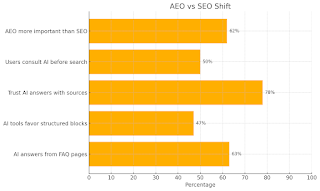
A horizontal bar chart illustrates changing behaviors among marketers and users in response to AI. It reveals that 62% of marketers now focus more on Answer Engine Optimization (AEO) than traditional SEO, 50% of users turn to AI tools before search engines, and 63% of top AI-generated responses are sourced from pages rich in FAQs. The chart underscores AI’s increasing reliance on well-structured, authoritative content.

AEO Decoded: What It REALLY Means to Be the "Answer" Online.


So, if AI is delivering one direct answer, what's your role in that? That's where AEO comes in. Answer Engine Optimization is about shaping your online content to be precisely what AI models are looking for when they formulate their singular, direct responses.

Forget just "keywords." AEO is about:

  • Clarity above all else: AI isn't going to dig for information. It needs crystal-clear, unambiguous answers to specific questions.Content That AI Loves

  • Trust as Currency: AI learns what's credible. Your content needs to scream authority and accuracy through verified facts and clear expertise.

  • Context is King: Providing the full, helpful picture without unnecessary fluff. AI wants comprehensive, yet concise, answers.

  • Structured for Scannability: AI loves organized data. Think headings that are questions, bulleted lists for key points, and short, sharp paragraphs. If it's easy for AI to parse, it's more likely to be chosen.

Essentially, AEO means transforming your online presence from a collection of potential links into a library of definitive, trustworthy answers. It’s about becoming the go-to authority that AI trusts enough to quote directly.

Content That AI Loves: Crafting Your Message for Instant Answers.


Now that we know what AEO is, how do you actually make your content "AI-friendly"? It's simpler than you might think, but it requires a shift in mindset from just writing for human eyes (though that's still vital!) to writing for AI comprehension.

Here’s the punchy breakdown of what content AI truly loves:

  • Be a Straight Shooter: Get to the point. If the question is "What's the best way to clean a rug?", give the method directly. No lengthy intros. AI prioritizes direct answers.

  • Use Q&A Formatting: Create dedicated sections that explicitly ask and answer common questions. Use those questions as your headings (<h2>How long does your service take? </h2>). This is pure gold for AI.

  • Facts, Facts, Facts: Back up your claims. AI values accuracy and verifiable information. Cite sources where appropriate. If it's factual, AI trusts it more.

  • Embrace Bullet Points & Lists: AI devours organized data. Summarize key takeaways in easy-to-read lists. It helps AI quickly extract the most important information.

  • Show Your Expertise: Who wrote this content? Why should anyone trust it? Ensure your expertise (and your team's) is clear. Author bios, testimonials, and case studies build authority.

  • Keep it Fresh: Outdated information is a no-go for AI. Regularly review and update your content to ensure its current and accurate. AI prefers the latest, most relevant data.

By implementing these tactics, you're not just creating good content; you're creating answer-ready content that AI will pick up and share directly with users.

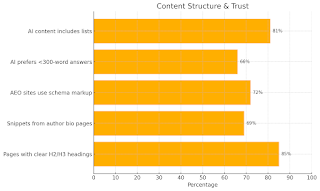
This horizontal bar chart highlights the content characteristics AI relies on most when choosing answers. It reveals that 81% of AI-selected content includes bullet points or numbered lists, 66% features responses under 300 words, 72% of AEO-optimized sites use schema markup, 69% of top snippets provide author bios, and 85% incorporate H2 or H3 subheadings. The data emphasizes how clear formatting and credible elements enhance content visibility in AI results.


Local Domination: How AEO Makes You the Go-To in Your Neighborhood.


Think AEO is only for global brands? Think again! For local businesses, AEO is a game-changer that can put your miles ahead of the competition. When someone asks an AI tool for a service "near me" or "best [your product] in [Your City, ON]," that AI is looking for local answers.

Here’s your local AEO power-play:

  • Your Google My Business (GMB) Profile is Gold: This is your primary local AEO weapon. Keep it meticulously updated: exact name, address, phone (NAP consistency!), precise hours (including holidays), high-quality photos, and detailed service descriptions. AI pulls heavily from GMB for local answers.

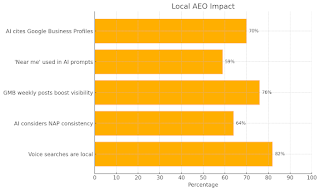
This horizontal bar graph illustrates the impact of local optimization on AI-generated responses. It shows that 70% of AI-powered local answers reference Google Business Profiles, 59% of queries include “near me,” 76% of active GMB profiles achieve greater AI visibility, 64% of AI results consider NAP (Name, Address, Phone) consistency, and 82% of voice searches have a local intent. The data underscores the increasing importance of local SEO strategies in enhancing AI-driven visibility.

  • Master Local Questions: Create website content that directly answers local questions. Think blog posts like "Top 5 Plumbers in [Your City]" (and make sure you're one of them, with a clear, concise profile!), or service pages explaining "Our HVAC Services in [Your Neighborhood]."

  • Local Proof Points: Encourage local reviews on your GMB profile and other relevant platforms. AI uses these as trust signals. Showcase local case studies or testimonials on your site.

  • Geo-Tag Your Visuals: When uploading photos of your business or local projects, ensure they have location data. This helps AI connect your visuals to your physical location.

By making your local digital footprint crystal clear and packed with direct answers, you position your business to be the top, trusted response when local customers ask AI for recommendations.


Fatal Flaws: 7 Common Mistakes That Kill Your AI Visibility.


So, you're excited about AEO   fantastic! But just as there are "dos," there are crucial "don'ts" that can sabotage your efforts. Avoid these common missteps if you want your content to be seen by AI:

  1. Sticking to "Old SEO" Only: Relying solely on past keyword-stuffing tactics is like bringing a horse and buggy to a Formula 1 race. You'll be left in the dust.

  2. Ignoring AI Tools Themselves: You can't optimize for something you don't understand. Use ChatGPT, Gemini, Perplexity. See how they answer. See what content they pull. Learn from them!

  3. Vague or Fluffy Content: AI hates ambiguity. If your content is full of marketing jargon, overly promotional fluff, or just skirts around the actual answer, AI will skip it. Be direct.

  4. Forgetting User Intent: Don't just think about keywords. Think about the question a person is trying to answer. If they type "how to fix a leaky faucet," they want steps, not a sales pitch for your plumbing service (at least, not initially).

  5. Lack of Authority/Trust: If your website looks sketchy, lacks proper "About Us" information, doesn't use secure connections (HTTPS), or has no author credibility, AI won't trust it. Trust is paramount.

  6. "Answer Stuffing": Don't try to cram every possible question and answer unnaturally onto one page. AI is smart. Focus on quality, natural language, and clear answers.

  7. Ignoring Voice Search Nuances: Voice search often involves longer, more conversational questions. If your content is written only for short keyword phrases, it might miss out on these opportunities.

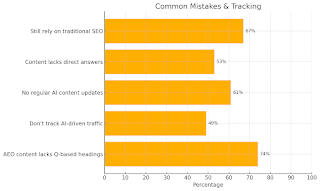
This horizontal bar chart highlights common AEO mistakes businesses make. It reveals that 67% continue relying only on traditional SEO, 53% don’t deliver clear, direct answers, 61% overlook updating content to stay AI-relevant, 49% fail to monitor AI-generated traffic or citations, and 74% of underperforming AEO content lacks question-focused headings. The chart pinpoints critical missteps where outdated approaches undermine AI visibility.

Bypass these pitfalls, and you'll be well on your way to becoming an AI-preferred answer source.


Proof's in the Pudding: Simple Ways to See Your AEO Working.


You're putting in the AEO work, but how do you know if it's paying off? Measuring AEO isn't as straightforward as a simple ranking report, but there are clear signals to watch for:

  • Direct AI Citations: The clearest win! Search your industry's common questions on Google (especially with AI Overviews enabled), ChatGPT, or Perplexity. Do you see your brand or website content cited as the source for the answer? That's your AEO mojo in action.

  • Google Search Console Deep Dive: Look beyond traditional keyword rankings. Pay attention to "People Also Ask" sections that your content triggers. See if your pages are getting impressions or clicks for direct, question-based queries.

  • Increased Brand Visibility (Qualitative): Are customers mentioning they "found you through AI" or "got your info from a smart assistant"? This invaluable feedback shows you're becoming an answer authority.

  • Traffic Quality: If your website analytics show lower bounce rates and longer session durations from organic search, it might mean AI is doing a better job pre-qualifying users and sending you highly relevant visitors.

  • Monitoring AI Tools: Stay proactive. Regularly ask AI tools questions related to your expertise and see what answers they provide. This helps you identify gaps or opportunities to improve your content.

AEO measurement is evolving, but by looking for these direct and indirect signals, you can clearly see your efforts bearing fruit.


Your AEO Launchpad: Getting Started with Answer Engine Optimization Today.


Ready to launch your AEO strategy and start being THE answer online? It's not about a total overhaul; it's about smart, focused adjustments. Here’s your actionable plan to kick things off:

  1. Listen to Your Customers: What questions do they constantly ask? What problems do they need solved? These are your AEO goldmines. Check emails, support tickets, and even what people search for on your site.

  2. Audit Your Top Content: Pick your 5-10 most important pages or blog posts. Do they directly answer a core question? Can you add a short, clear "answer box" at the top? Break long paragraphs into bullet points.

  3. Build a FAQ Powerhouse: Create a dedicated FAQ page (or enhance an existing one) that answers all those common customer questions in a concise, structured Q&A format.

  4. Optimize Your GMB (Seriously, Do It Now!): For local businesses, this is non-negotiable. Fill out every single field, add great photos, ensure consistent NAP (Name, Address, Phone) across the web, and encourage reviews.

  5. Focus on Clarity, Not Keywords: When writing new content, prioritize being absolutely clear and direct. Imagine you're explaining something to a friend who needs a quick, precise answer.

  6. Start an "Authority Builder" Blog: Create new blog posts that answer specific, detailed questions in your niche, demonstrating your expertise.

  7. Stay Curious & Adapt: The AI landscape moves fast. Keep playing with AI tools, see how they evolve, and adjust your content strategy accordingly.

By taking these steps, you're not just waiting for the future; you're actively building your business's presence in it.

Additional Resources:


Ask AI Anything: Top Questions About AEO, Answered Simply.

Let's tackle some common questions you might still have about this exciting shift:

What's the #1 takeaway for AEO?
Be clear and direct. Your content needs to be unambiguous and answer questions immediately.

Is AEO going to replace SEO completely?
No. Think of AEO as the evolution of SEO. Traditional SEO helps get your content found. AEO helps it get chosen as the direct answer. They work together.

Do I need special software for AEO?
Not initially. Most AEO is about how you write and structure your content. Standard content management systems and good writing practices are your best tools.

How long does it take to see AEO results?
Like SEO, it’s a marathon, not a sprint. Consistency is key. You might see some quick wins with well-optimized content, but sustained effort brings long-term visibility.

Will AI just "steal" my content and I get no traffic?
AI provides summaries. While it gives direct answers, good AEO often includes clear citations, prompting users who need more detail or service to visit your site. It's about being the trusted starting point.

Is AEO harder than traditional SEO?
It's different. It requires a deeper understanding of user intent and clarity, rather than just keyword density. In many ways, it's about writing genuinely helpful content, which is always good practice.

What's the single most important thing for local AEO?
Your Google My Business profile. Fully optimized, accurate, and regularly updated  

 it's your local answer engine powerhouse.

The Future is Now: Your Business in the Age of Answer Engines.

The shift to Answer Engine Optimization isn't just an interesting development; it's a critical moment for every business owner. The way people find information, make decisions, and discover businesses has fundamentally changed. If your content isn't built to be the clear, direct, and trusted answer, you risk fading into the digital background.

This is your moment to adapt, to innovate, and to claim your rightful place as "THE Answer Online." Embrace AEO, and ensure your business isn't just present, but truly dominant, in this exciting new era of search.


“Bio: Maede is a content curator at UnlimitedExposure, a company dedicated to providing a wide range of digital marketing resources. Their expertly curated content helps both beginners and seasoned professionals stay ahead of industry trends. Whether you need beginner-friendly tutorials or in-depth analyses, UnlimitedExposure equips you with the knowledge to grow and succeed in today’s fast-paced digital world. Explore their collection to enhance your skills and stay competitive. 

UnlimitedExposure Online is also recognized a SEO Services in Toronto”